Air conditioning
Exhaust system
Welding
Lowering and coilovers

Home/Services/Four-wheel alignment
Suspension and steering
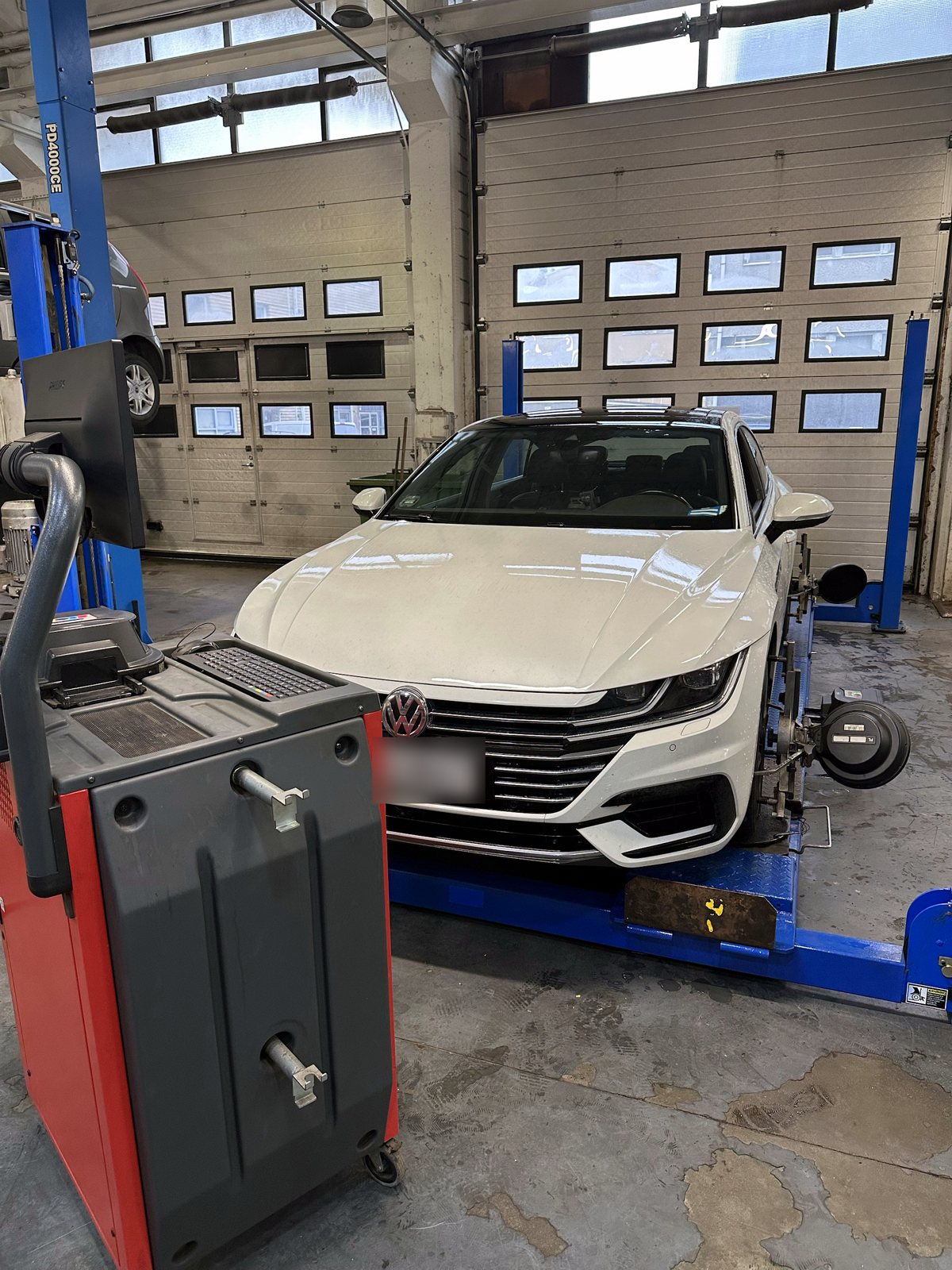
We do 3D four-wheel alignments on passenger cars and small vans. The measurement checks the angles of all four wheels, and we adjust the toe and camber settings in the car’s design to the extent they are adjustable on that car.
The price applies to passenger cars and small vans when the suspension, steering and adjustment parts are in good condition and can be adjusted normally.
Before the alignment – we recommend
The adjustment bolts are opened with normal force. A brittle bolt can break without warning. How we work and what we are responsible for ↓
When needed
Often needed on newer cars with a lot of electronics.
We do not do ADAS calibrations (cameras and radars).
Done only if the car’s design allows it. The price depends on the scope of the work.
Prices include VAT at 25.5%.
An alignment is advisable whenever a part that affects the wheel position has been touched — or when the way the car behaves tells you something is off.
A four-wheel alignment is not automatically needed after a seasonal tyre or wheel change.
Five steps, in the same order for every car.
Basic chassis inspection 20 € or extended chassis inspection with the adjustment bolts opened 30 €. Optional, but we strongly recommend it: a reliable adjustment requires the suspension and steering to be in good condition. Also includes checking and adjusting the tyre pressures.
We measure the angles of all four wheels and compare them with the values allowed by the manufacturer. If all values are fine and no adjustment is needed, we only charge for the measurement, 42.50 €.
The steering wheel is locked in the centre position. Toe and camber are adjusted to the extent the car’s design allows.
After the adjustment we usually do a short test drive and check the result of the work and the position of the steering wheel.
You receive a report showing the wheel angle values before and after the adjustment.
Preparing the car is the customer’s responsibility: we recommend removing extra and unusually heavy items from the car before the alignment, as extra load affects the ride height and suspension geometry. Checking and adjusting the tyre pressures is part of the paid chassis inspection (20 € or 30 €).
We give a 14-day follow-up check guarantee on four-wheel alignment.
If, after the alignment, the steering wheel is clearly off-centre when driving on a straight road or there is reason to doubt the result of the adjustment, we check our work free of charge within 14 days of the work being done. If the problem is due to our adjustment, we correct it at no extra charge.
If a chassis inspection was done and paid for with us before the four-wheel alignment, but despite the inspection a suspension fault is later found that should have been noticed during the inspection, we do a new four-wheel alignment after the necessary repair without a new alignment fee. If the customer did not want a chassis inspection before the alignment, the new alignment needed after the repair is charged normally.
A four-wheel alignment and an extended chassis inspection (30 €) cannot be done without opening the adjustment bolts and nuts. In Finnish conditions they have often rusted solid or become brittle. We act in one of two ways, depending on what happens when the bolt is opened.
On some cars the adjustment bolts are so brittle that they break under normal opening force without any warning. This cannot be seen or predicted in advance. By ordering the alignment or inspection you accept this risk, and we are not liable for a part broken in this way.
If the bolt does not open with normal force, we stop and tell you about the risks. Extra force, heating or cutting is only used with your permission. If you give permission, any damage to the part or nearby rubber parts and wiring is the customer’s responsibility.
We tell you straight away what happened. You can take the car as it is, or we give you a price estimate for the repair. The repair is not started until you have approved the price.
We are responsible for damage caused by incorrectly done work. The 14-day follow-up check guarantee and the conditions described above do not limit liability for defects in our work under the Consumer Protection Act.
Caster angle adjustment is not included in the 79 € price of a normal four-wheel alignment. On most cars the caster angle cannot be adjusted, or a separate adjustment is not normally needed.
If the customer wants the caster angle adjusted and the car’s design allows it, the price estimate is approx. 42.50 €. The final price depends on the scope of the work.
The 79 € price applies to a normal four-wheel alignment to the car manufacturer’s standard values. Priced separately are, for example, individual coilover settings, heavily lowered cars, special settings for racing and hobby cars and wheel angles requested by the customer that differ from the manufacturer’s standard values. In these cases the price of the work is estimated separately.
The result of a four-wheel alignment can be affected by, for example, play in ball joints, worn tie rod ends, play in the inner tie rods, damaged or loose bushings, significant play in wheel bearings, broken springs and damaged or bent suspension parts.
If faults like these are found, it is worth repairing them before the final alignment.
In Finnish conditions, suspension adjustment bolts and other fasteners can rust and seize badly. The wheel angles can usually be measured, but if an adjustment bolt or mechanism does not move or its range of travel is not enough, it may not be possible to adjust to the desired value.
In that case it may be necessary to free or remove the adjustment joint, replace an adjustment bolt, cut a rusted bolt or replace a bushing or control arm. Extra work and the necessary parts are charged separately.
You can find out the condition of the adjustment bolts in advance with an extended chassis inspection (30 €): we open the adjustment bolts and nuts and check that they move. Liability for breaking parts ↑
On Volkswagen, Škoda, SEAT and Audi and some Fords (for example the Focus), the rear axle adjustment bolts often rust into the inner sleeve of the control arm bushing. The bolt turns with the bushing, and the rear wheel alignment cannot then be adjusted properly.
The solution is to cut the bolts and replace the control arms completely – new control arms are usually sold as a set with adjustment bolts. The work takes about 2 hours, sometimes more depending on the car’s design and access. The average labour price is 170–212.50 €, a pair of control arms approx. 120–130 €. A four-wheel alignment is done after the replacement.
Depending on the car’s design, adjustable values can include front toe, rear toe, front camber and rear camber.
Not every measurable angle can be adjusted with the original adjustment parts on every car. If a value is outside the range allowed by the manufacturer but the car has no adjustment for that angle, the cause may be, for example, suspension wear, a damaged or bent part or the car’s design. In that case a further inspection or repair may be needed.
A car pulling to one side is not always caused by incorrect wheel angles. The cause may be a suspension or steering fault, the condition of a tyre or damage to it, a braking system fault, a bent suspension or body part, the camber of the road or another technical fault.
If the cause of the car pulling to one side is not known, we recommend first finding the cause of the problem and then doing the necessary repair or adjustment.
If the steering wheel is off-centre when driving on a straight road, one possible cause is incorrect toe adjustment. During a four-wheel alignment the steering wheel is locked in the centre position and the wheel angles are adjusted within the limits allowed by the car’s design.
On some cars the steering system and suspension structures can have relatively large normal play by design. Because of this, a perfectly straight steering wheel is not always achieved with the first adjustment, and a small further correction may sometimes be needed. If you notice after the work that the steering wheel is clearly off-centre when driving on a straight road, please contact us.
After the four-wheel alignment, the customer receives a measurement report showing the wheel angle values before and after the adjustment. The report shows which values were outside the manufacturer’s range before the adjustment and to which values they were adjusted.
The four-wheel alignment measurement report of a lowered car can be used in the modification inspection if needed. That is why it is worth keeping the measurement report after adjusting a lowered car.
A four-wheel alignment determines and adjusts the car’s wheel angles at the time the work is done. We do not give a long-term guarantee on even tyre wear based on the alignment alone, because many other factors affect wear: the design and condition of the tyres, tyre pressures, the condition of the suspension and shock absorbers, the car’s load, driving style and operating conditions, and hitting potholes or kerbs.
If there is reason to suspect after the alignment that the wheel angles are not right, we can measure them again and find out what is going on.
A four-wheel alignment is essential after replacing an outer tie rod end, an inner tie rod or the steering rack. After other suspension repairs, the need for an alignment depends on the car’s design and which parts were removed or replaced during the work.
After fitting lowering springs, coilovers or another ride height change, the wheel angles should be checked, because changing the ride height affects the suspension geometry.
We recommend booking by phone. We agree the exact time at the same time, so the work is done while you wait and you do not need to leave the car with us for the whole day.
Tell us these five things, and we can book the right amount of time for the job:
If the condition of the suspension is not known, we recommend a chassis inspection first.
Call 050 599 0357 (Mon–Fri 9–17)
or message us on WhatsApp or email asiakaspalvelu@primpex.fi


